Tuesday, 17 November 2015

HA12 Task 1 - Analysis

For this task I will be analysing the Strategy genre. I will be looking at multiple games within the genre and look at their similarities. 

The majority of strategy games do not feature one controllable character, but might instead put you in control of a squad, or an entire army. They also have a moveable camera placed above the battlefield, giving you a better view of what you are doing in the game. 
The objective for many mutliplayer strategy games is to eliminate the enemy player(s) or capture and defend certain locations or victory points. One example of this is Company of Heroes 2, a world war 2 strategy game in which the player can create and control squads of infantry, and eventually upgrading into armoured vehicles, artillery and tanks. 
The player's objective is to destroy the enemy's base, but they must also control vital resource points, which will give them the resources they need to upgrade and expand their army.

Another type of strategy would be 'Grand Strategy', in which similar scenarios might occur, but on a much larger scale. An example of this type of game would be the Total War games, in which the game has a Campaign Screen, in which the economy, army and city building would occur, and the Battle Screen, in which the fighting with said armies would occur, with almost every unit being comprised of over 100 men.


(Source)
HUD & UI

The common setup for strategy games such as Company of Heroes and Starcraft is to have all of the details and information about the player units on the bottom of the screen, with the right side being dedicated to showing constructable buildings or units, or sometimes certain commands that can be given to units. 
The left side of the screen has the minimap, a tiny and simplified version of the battlefield the player is wrestling for control of. It can alert the player to any units or structures being attacked, or an enemy group trying to move forward into your lands, and makes the game a bit more manageable.

In games such as Starcraft, your units won't have an icon above them to show what units they are, so the player must rely on the look of the unit to find out what it is, but they will have the health of the unit/squad above them to show how much damage they have sustained.
Somewhere on the screen, the player's resources would be shown. In the case of Starcraft, resources are shown in the top right of the screen, as well as the unit capacity.
(Source)
Company of Heroes 2 also shows the game's resources: manpower, munitions, fuel, but also show how much of that resource the player makes in a certain amount of time.

Story
Typically, strategy games will have campaigns, which can be anything from a fully-fledged story with the gameplay and objectives tied into it, like the Starcraft games, to a game such as Dawn of War, which only gives a basic background of why you are there, and then leaves it up to you to choose what to do, progress and complete the game.

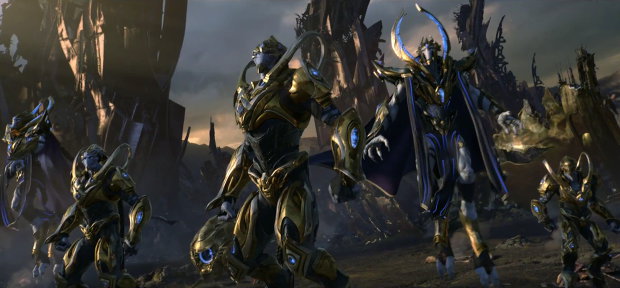
(Spoiler alert) In the newest Starcraft expansion, Legacy of the Void, the main characters must completely destroy a planet because it has been overrun by the Zerg that are pouring through a portal from another world, but the only way to do so is to overload an ancient temple. 
The characters decide to try and defend the temple as long as they possibly can, so that they can kill as many zerg as possible and weaken the remaining enemy army. The player is then placed into the map, next to said temple, and must defend it from waves of enemies coming from every direction until they are able to overload the temple. The majority of story development is shown through cutscenes, but small developments can be presented through the gameplay.
(Source)
In Dawn of War, however, the player is given a small amount of backstory, being told that every faction in the game is fighting for the control of the planet, and your faction (whichever one you choose) must be victorious. The player is then dropped onto a map that shows each faction's territory, and then it is completely up to the player who they conquer and how, with the story from that point being almost non-existent.

Company of Heroes 2 is a historical strategy game, and like most others, the story follows the general flow of how World War 2 actually happened. One mission involves you playing as the Russians, and reclaiming Stalingrad from the German forces.

Characters
Certain characters, mainly characters that have major parts in the game's story, can be involved in the gameplay itself, either acting as a 'champion' or hero character, who is much stronger than most other units and has a variety of usable abilities. Some characters can also act as a tactical advisor, explaining new enemies, events, etc. to the player as they are progressing through the game.

All 3 storylines in Starcraft 2 have such characters. The player indirectly plays as the main characters Jim Raynor, Kerrigan, and Artanis, and occasionally those characters will be playable along-side regular units in special missions. These characters can explain new units and abilities without directly addressing the player, but those characters also have their own advisors, who will give information to them, and by extension the player. 


(Source)
Company of Heroes 2 does not feature any special playable characters, but will instead have a generic soldier or general shout orders or quickly explain new things to the player.

Mechanics
What many strategy games share, is the gameplay feature to build up bases and create stronger and larger armies, in an attempt to destroy the enemy or capture vital points. At the beginning of a game, the player would only have the most basic structures, and only be able to create the weakest units. 
Over time, as the play collects more resources and builds more complex structures, more and more options open up to the player, making them choose which route they wish to go with the build of their army.

For example, in Starcraft 2 as the Protoss race, the player will start off with their main base Nexus, and 6 out of 24 probe workers collecting minerals, sometimes having 1 structure called a gateway to allow them to build basic melee units. As the probes collect minerals, the player will be able to afford another structure called a cybernetics core, which will unlock another, stronger, unit in the gateway. 
The player could also create a forge, which would allow the player to upgrade their units' damage/armour/shields, and also construct a defensive structure to keep the base safe from attacks.

Also, in Company of Heroes 2, certain types of units are separated and locked into certain structures. One structure might allow for better infantry troops to be deployed, but another might allow for light or heavy armoured vehicles and tanks. This is much easier for the player to learn and manage, as they can simply look at what type of unit is unlocked, and decide whether they want those types of units, instead of needing to create a building they might otherwise ignore, just to be able to unlock what they actually want.

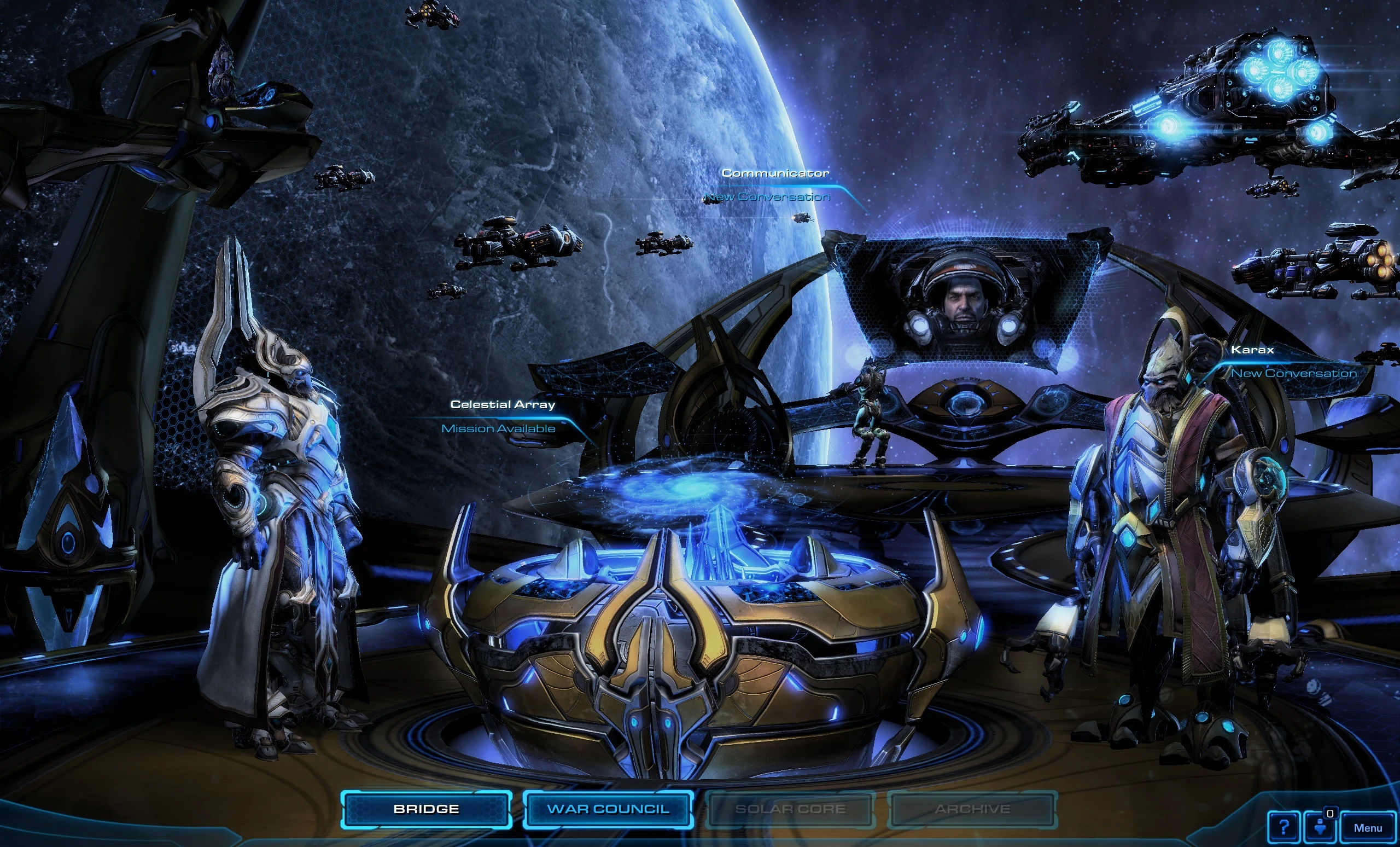
During singleplayer campaigns, some strategy games might have a 'hub' or a location they will visit between missions, and make certain decisions that will affect gameplay. In Starcraft 2, the player is transported to their ship after missions, and can interact with certain characters and speak about their opinions and what they advise. 
(Source)
The player can also choose certain upgrades for specific units, usually deciding between 2 different paths for each unit. One expansion allows you to upgrade the main character, as they are playable within the expansion's missions, and give them abilities of your choice, that suit your play style.

Audience
I would say that it isn't very easy to define the audience for strategy games, as there are many types of games that fit into the genre, and cover a wide variety of people. 
Many strategy games focus on violence, in some form or another, which I believe would not appeal to women as much as it would for men.
Many of the games also require good focus and reaction times, which may be more suitable for a young adult audience, as they would be at their 'peak'. Some strategy games are quite slow-paced, which could be more suitable for younger people, and also quite older people too.

Conclusion
To conclude, I believe that the majority of strategy games can be easy for people to get into, but can be extremely difficult for people to master, meaning that it takes practice, skill, and dedication to become 'good'. I believe this to be why the competitive scene in strategy games is so large, because it is very entertaining to see those who have mastered the game compete against each other.

HA11 Task 2 - Effects Debate

The BBC's 'Horizon' series recently aired a video game related episode, called 'Are video games really that bad?'. The show investigated the idea that video games can cause violence that would otherwise not happen, because of many violent events being blamed on the effect of video games on people.

The episode featured people such as Craig Anderson of Iowa State University, and Brad Bushman of Ohio State University, who spoke of their studies and what they have found in relation to video game violence and other effects. They both say that video games are not responsible for violent acts, but can cause small increases in real-life aggression, and change how people think about violence. They state that this is because of the tendency of video games to reward players for doing violent acts in the games.

I believe this to be true, as sometimes after playing a violent video game, or a game that can make you angry and frustrated, in the short term you may be more likely to lash out or be aggressive towards people or things in the real world. Although I don't think a violent act would be committed unless you were already prone to doing so beforehand.

Professor Chris Ferguson of Stetson University has said that video games have actually led to a decrease in violent acts, especially in young people. Ferguson has a 'routine activities theory', which states that if you take people that are prone to aggressive and violent acts, and give them something else to do such as video games, then they will be less likely to commit acts like bullying out in the real world because they are occupied and kept away from opportunities to be violent.

An experiment was conducted by Dr Doug Gentile, in which a group of subjects competed in a timed reaction test. The winner was given the chance to choose the level of punishment for the other participant, which was the volume of an obnoxious sound that would be played. It was found that people who played violent video games were more likely to choose a much louder sound that those who hadn't, which would show they have more aggression.

Later in the program, two video game developers called Ian Livingstone and Tim Shafer spoke about the subject. Livingstone said that the people that accuse video games of causing the violent acts have never played a single video game in their lifetime. He also said that video games cause aggression in the same way as many other hobbies and activities, such as sports matches. Tim Shafer said that the same accusations about violence and video games were made about comic books and films when they were new to the world.

A researcher at Oxford University, Dr Andrew Przybylski, used the game 'Bastet' (an extremely frustrating version of Tetris) to see how much frustration impacts aggression. In his experiment, he had half of the subjects play a normal game of Tetris, while the other half would play Bastet. At the end, the results showed that those who played Bastet had more aggression than those who played Tetris.

I believe that frustration is a big part of increased aggression. A poorly made video game that does not work properly could make the player just as frustrated as someone who is playing a violent game, and could result in a similar amount of aggression.

Dr Valerie Voon then came on the show to discuss how video games can be addictive and the effect it can have. Dr Voon performed an experiment on a subject who played video games for around 20 hours a week. She wanted to see whether they would accept a smaller reward immediately or a larger reward at a later date. Then the subject was asked to play a game while hooked to an MRI scanner. The subject would press a button as quick as they could when a star appeared on the screen. Every time they pressed the button quick enough, they were rewarded with money. At the end, the theory of video game addiction was disproved, as the subject had fallen into the healthy category of game addiction.

Some people believe that video games can be used to help people, instead of just being used for entertainment. A video game called Underground was created, which used a specialised controller to train keyhole surgery, after it was found that surgeons that player video games seemed to have better skills in keyhole surgery. 

To conclude with my own opinion, I don't believe that video games cause violent acts, and they can actually be used to benefit people in many ways, such as memory training and reaction times. I think that people that commit violent acts and blame it on video games would have been likely to commit the act anyway, without the influence of video games. Or perhaps video games were the final trigger for them to commit such acts. Video games can cause slight aggression, but for the majority of people this is only for the short term, and after some time they return to their normal state of aggression.

Tuesday, 3 November 2015

HA11 Task 1 - Glossary

The Hypodermic Needle Model
This theory says that mass media can influence large groups of people by 'injecting' them with certain messages to trigger the responses that they want. This theory originated in 1938 when 'The War of the Worlds' was broadcast on radio, and accidentally caused widespread panic when some people believed the broadcast was real.

This theory was later proven to be untrue, as researchers found that people are much more likely to be influenced by other people, especially those close to them.
The Inoculation Model
This theory is used to show that people can be influenced so that their own opinions are reinforced, and are more likely to further resist new or conflicting ideas, and reject any persuasion to anything they don't believe.

The idea is that the receiver must be given arguments against their beliefs, not strong enough to change their view, but enough to make them defensive. Over time, the receiver would be able to create stronger defensive arguments.

The Two-Step Flow Model
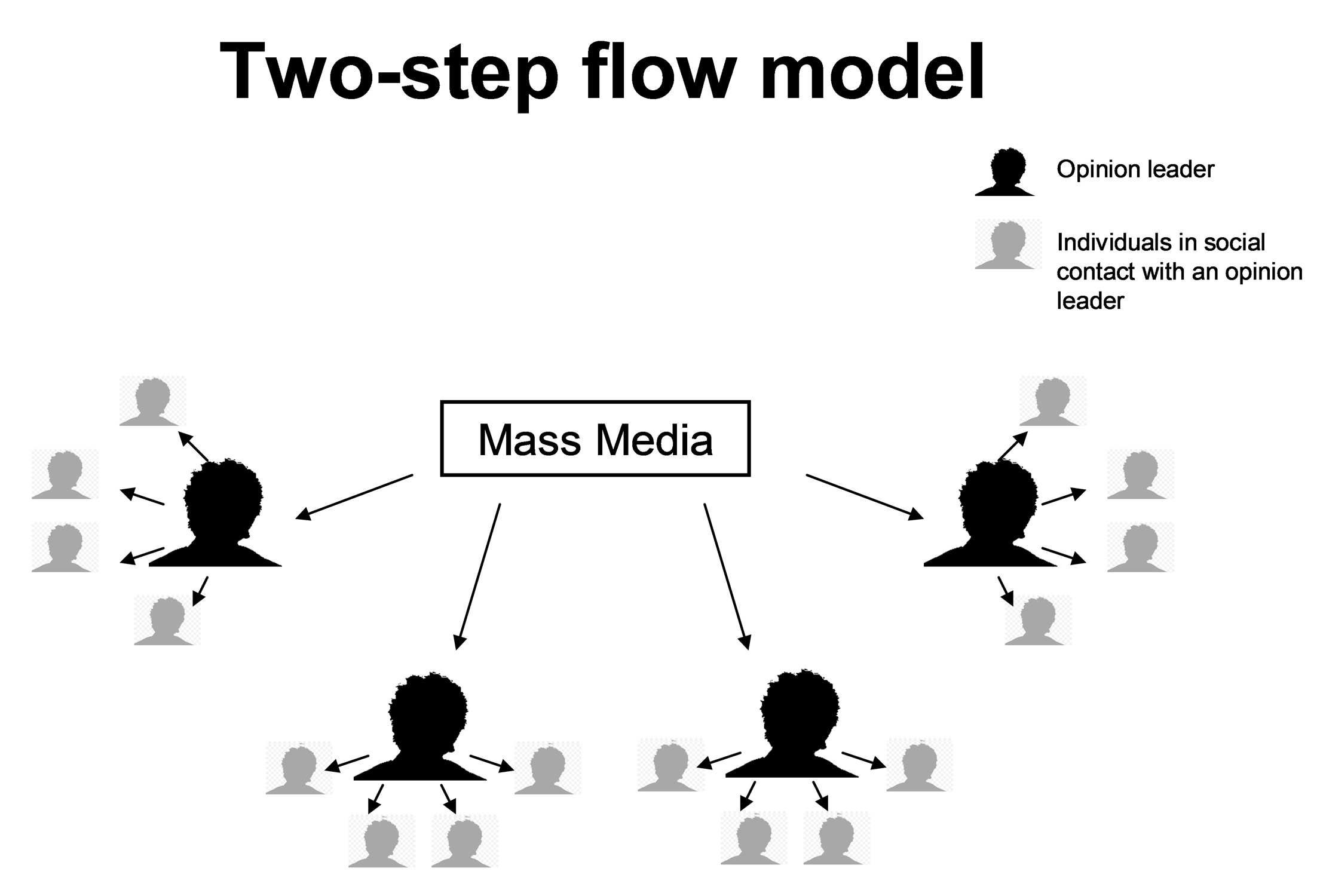
This theory says that most people have their opinions influenced by 'opinion leaders', who are influenced by the media, meaning that the wider population is influenced indirectly by the media. 
(Source)
A modern example of this model at work is with youtubers as the opinion leaders. With youtubers, the relationship with the audience is much more personal than directly with the media, and the audience may be more likely to believe what the youtuber tells them from the media.

The Uses & Gratifications Theory
This theory attempts to explain why and how people use media. It says how people deliberately pick media which suits their needs for relaxation, knowledge, social interaction, etc.

The theory assumes that people actively consume media, instead of sitting passively. The audience has power over media, as the media changes and adapts to try and suit the audience's desires, while competing with other kinds of media.

The Reception Theory
The reception theory says that the media isn't passively accepted by the viewer, but is interpreted in different ways based on their background and experiences. People with very different experiences may interpret media in completely different ways.

Tuesday, 20 October 2015

HA10 Task 4 - Conclusion

After completing my deconstruction and survey about Just Dance and The Last of Us in the previous tasks, I believe I know the types of games these are, and the type of audiences they are targeting.

From the deconstruction, I have found that both games are vastly different from each other. Just Dance is a light-hearted dancing game, meant to be played by groups of friends or family. The game uses a lot of bright colours, and seems to be a very casual game. It has a complete lack of a story of any kind, and is completely about the gameplay and bright and colourful visuals, which would make it much more appealing to a younger group of people, or a family with young children.

The Last of Us is much more story-oriented than Just Dance, and has a dark and gritty atmosphere, which is more suitable for adults and older players, than young groups like for Just Dance. Because of how story-oriented it is, this game seems to be targeted at dedicated gamers, people that can put a lot of time into video games and like to be immersed in them.

After my deconstruction, I created a survey to try and find evidence of what I found. I believe the survey went much better than my previous survey for GTA 5, because I was also to gather more responses and ended up with a more diverse range of answers, which mostly supported what I found in the deconstruction. 80% of the people that responded had played Just Dance, with friends or family, and were between the ages of 15 and 18. Only 60% of people had played The Last of Us though, which shows that Just Dance might be a more casual and easier game.

To conclude, I think that these two games are vastly different from each other, were made for completely different kinds of people, and were made to fulfil separate desires. Just Dance is a very casual game, and is meant for younger people that may want to play for social interaction. The Last of Us is a game for more dedicated players, and is played for the story-driven aspects instead.

HA10 Task 3 - Questionnaire

After my deconstruction of the games Just Dance and The Last of Us, I created a survey, once again using SurveyMonkey, to find out what type of people play these games.
I feel as though this survey went much better than my previous survey on GTA 5, because I was able to gather more responses from people.

My first two questions were to find out the gender and age of my participants. There were more 2 male responders than females, and just over half of the responders were between the ages of 15 and 18.


The next question was whether they had played Just Dance before. Most people responded with yes, with only 2 people saying no. Both who said no were males, one between 15 and 18, and the other did not answer.


Then I asked what everyone though of the game, as an open-ended question. Most of the responses were positives, saying that it is best to play with friends/family. The following question confirmed this, as most people said that they play Just Dance with others. These results prove that Just Dance is best played with friends and family.


The final question about Just Dance was for their overall rating of the game. Half of the responses gave it 4/5, with 2 for both 3/5 and 5/5. Both of the people that said 3/5 had commented earlier that they didn't play with other people, which shows that the game is meant to be enjoyed with other people.


Afterwards, I asked each person the same series of questions, but this time about The Last of Us. A larger number of the responses said no, with them being 2 males and 2 females. When compared to the results from the gender question, half of the female responders said no, which could show that the game appeals slightly more to males.


Once again, I asked what people thought of The Last of Us. All of the responses positively mention either the story or the gameplay. 2 responses mention parts of the game are creepy, and this could potentially mean that this game is meant for older players.


Because The Last of Us has a multiplayer mode, I also asked whether people played it with or without other people. Half of the participants do not play the multiplayer mode, but out of those that do, more people played by themselves.


Again, I asked for their overall rating of The Last of Us. The results were even out of 6 responses, 2 people chose each option from 3/5 to 5/5.


HA10 Task 2 - Deconstruction

In this task I will be looking at the games Just Dance and The Last of Us, their audiences, and how the games are presented to them. Firstly, I will be looking at the covers for each game, and comparing them.

(Source)
(Source)

The difference between the covers is quite apparent. It is obvious that both games appeal to vastly different audiences.

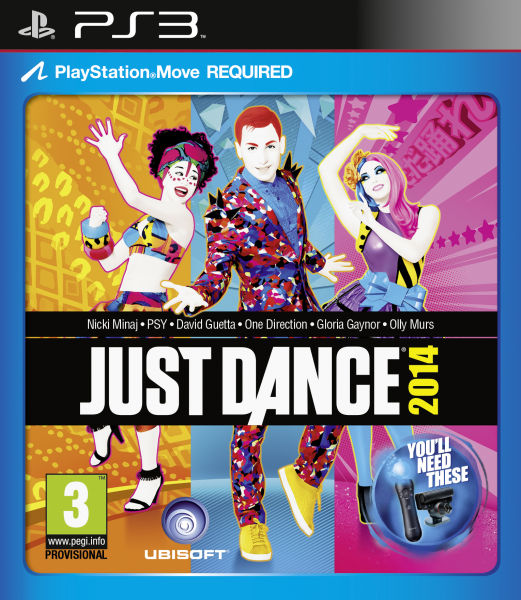
Just Dance's cover is filled with bright colours and smiling people, and has a really cheerful tone. It also looks to be a quite physically active game, which suggests that the game may be for a younger audience.
The Last of Us' cover uses darker colours, and both characters look serious, so the audience for this game might be much older than Just Dance.

The way the text looks can also give insight into the type of audience it is aiming for. Just Dance's title is clean bright white and bold. It is also in the centre of the cover, trying to grab the attention of the audience.
The Last of Us' title is also white, but worn down and slightly covered in dirt, which could relate to and show off the dark and gritty story in the game. The text is in the top-left of the cover, leaving the majority of the space to the characters in the background.

Another way to tell what type of audience the game is for, is by looking at the characters on the covers. For Just Dance, the people on it are smiling and dancing, and wearing bright clothing. The central character seems to be holding his hand out, inviting you to join in. Everything about them shows that they are in a safe and happy environment, and suitable for a much younger audience.
However, looking at the cover for The Last of Us, the two characters have a serious look on their faces. Their clothing is much darker and duller than on the Just Dance cover, and seems to match the tone that the game presents. The central character on this cover is facing away from the audience, and looking over her shoulder at them. Both characters are holding guns, which shows that the environment they're in is dangerous.

Now I will look at trailers for both games, as they can give a good idea of what audience they are aiming for.


Immediately when the trailer for Just Dance begins, upbeat music is playing, and a large group of characters are all dancing. This shows that it is meant to be played by multiple people at once. All of the colours are simple and bright, making it seem like a cheerful game. At multiple points in the trailer, it cuts to real people playing the game, which gives a much better look at what audience they are aiming for. The real players are all young adults, but it seems as though it could be played by a family too.


The trailer for The Last of Us is vastly different in pretty much every way. The trailer shows a lot of dark locations, with one having a large group of people running and screaming, and the other shows the silhouette of some unknown creature making a disturbing sound. Everything that the characters in the trailer say is said in a very serious and sometimes angry tone, with some characters even swearing. This shows that it is intended for an older audience than Just Dance. The game seems to be very story focused, which likely means it is meant to be played by a single person.

HA9 Task 4 - Conclusion

After looking through both my primary and secondary research, I believe I know what the target audience for GTA 5 is.

As I was looking at my secondary evidence, I came to the conclusion that the target audience for the game was for young males, around the age of 18. My reasoning is that the game features a male-dominant cast in the story, and the majority of the gameplay involves guns, cars, and general violence, which would seem to appeal much more to a young male audience than a female one.
The results of my primary research support this, as all of my responders were male, and most were below the age of 18.

Overall, I think that my secondary research was much more successful than my primary research. This is because it was much easier to gather information, due to GTA 5's popularity, and because of multiple controversies that have spawned from it. One piece of secondary information I used was quite similar to my primary research, but had many more responses, which better showed what type of audience the game has.

I struggled to find people to fill out my survey, as I had to make sure that every person that did it had played GTA 5 before, and I wanted to use people that I knew. To make my primary research better I could have put my survey out onto GTA 5 related online websites, which would have significantly increased the number of responses I received.