The majority of strategy games do not feature one controllable character, but might instead put you in control of a squad, or an entire army. They also have a moveable camera placed above the battlefield, giving you a better view of what you are doing in the game.
The objective for many mutliplayer strategy games is to eliminate the enemy player(s) or capture and defend certain locations or victory points. One example of this is Company of Heroes 2, a world war 2 strategy game in which the player can create and control squads of infantry, and eventually upgrading into armoured vehicles, artillery and tanks.
The player's objective is to destroy the enemy's base, but they must also control vital resource points, which will give them the resources they need to upgrade and expand their army.
Another type of strategy would be 'Grand Strategy', in which similar scenarios might occur, but on a much larger scale. An example of this type of game would be the Total War games, in which the game has a Campaign Screen, in which the economy, army and city building would occur, and the Battle Screen, in which the fighting with said armies would occur, with almost every unit being comprised of over 100 men.
 |
| (Source) |
The common setup for strategy games such as Company of Heroes and Starcraft is to have all of the details and information about the player units on the bottom of the screen, with the right side being dedicated to showing constructable buildings or units, or sometimes certain commands that can be given to units.
The left side of the screen has the minimap, a tiny and simplified version of the battlefield the player is wrestling for control of. It can alert the player to any units or structures being attacked, or an enemy group trying to move forward into your lands, and makes the game a bit more manageable.
In games such as Starcraft, your units won't have an icon above them to show what units they are, so the player must rely on the look of the unit to find out what it is, but they will have the health of the unit/squad above them to show how much damage they have sustained.
Somewhere on the screen, the player's resources would be shown. In the case of Starcraft, resources are shown in the top right of the screen, as well as the unit capacity.
 |
| (Source) |
Story
Typically, strategy games will have campaigns, which can be anything from a fully-fledged story with the gameplay and objectives tied into it, like the Starcraft games, to a game such as Dawn of War, which only gives a basic background of why you are there, and then leaves it up to you to choose what to do, progress and complete the game.
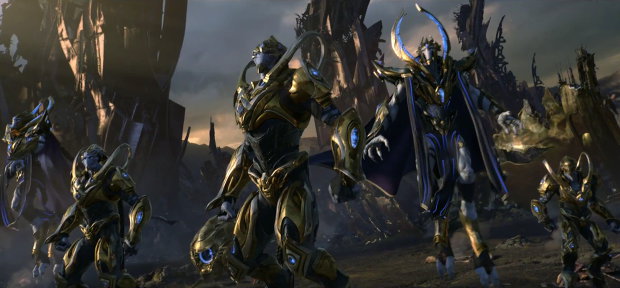
(Spoiler alert) In the newest Starcraft expansion, Legacy of the Void, the main characters must completely destroy a planet because it has been overrun by the Zerg that are pouring through a portal from another world, but the only way to do so is to overload an ancient temple.
The characters decide to try and defend the temple as long as they possibly can, so that they can kill as many zerg as possible and weaken the remaining enemy army. The player is then placed into the map, next to said temple, and must defend it from waves of enemies coming from every direction until they are able to overload the temple. The majority of story development is shown through cutscenes, but small developments can be presented through the gameplay.
 |
| (Source) |
Company of Heroes 2 is a historical strategy game, and like most others, the story follows the general flow of how World War 2 actually happened. One mission involves you playing as the Russians, and reclaiming Stalingrad from the German forces.
Characters
Certain characters, mainly characters that have major parts in the game's story, can be involved in the gameplay itself, either acting as a 'champion' or hero character, who is much stronger than most other units and has a variety of usable abilities. Some characters can also act as a tactical advisor, explaining new enemies, events, etc. to the player as they are progressing through the game.
All 3 storylines in Starcraft 2 have such characters. The player indirectly plays as the main characters Jim Raynor, Kerrigan, and Artanis, and occasionally those characters will be playable along-side regular units in special missions. These characters can explain new units and abilities without directly addressing the player, but those characters also have their own advisors, who will give information to them, and by extension the player.
 |
| (Source) |
Mechanics
What many strategy games share, is the gameplay feature to build up bases and create stronger and larger armies, in an attempt to destroy the enemy or capture vital points. At the beginning of a game, the player would only have the most basic structures, and only be able to create the weakest units.
Over time, as the play collects more resources and builds more complex structures, more and more options open up to the player, making them choose which route they wish to go with the build of their army.
For example, in Starcraft 2 as the Protoss race, the player will start off with their main base Nexus, and 6 out of 24 probe workers collecting minerals, sometimes having 1 structure called a gateway to allow them to build basic melee units. As the probes collect minerals, the player will be able to afford another structure called a cybernetics core, which will unlock another, stronger, unit in the gateway.
The player could also create a forge, which would allow the player to upgrade their units' damage/armour/shields, and also construct a defensive structure to keep the base safe from attacks.
Also, in Company of Heroes 2, certain types of units are separated and locked into certain structures. One structure might allow for better infantry troops to be deployed, but another might allow for light or heavy armoured vehicles and tanks. This is much easier for the player to learn and manage, as they can simply look at what type of unit is unlocked, and decide whether they want those types of units, instead of needing to create a building they might otherwise ignore, just to be able to unlock what they actually want.
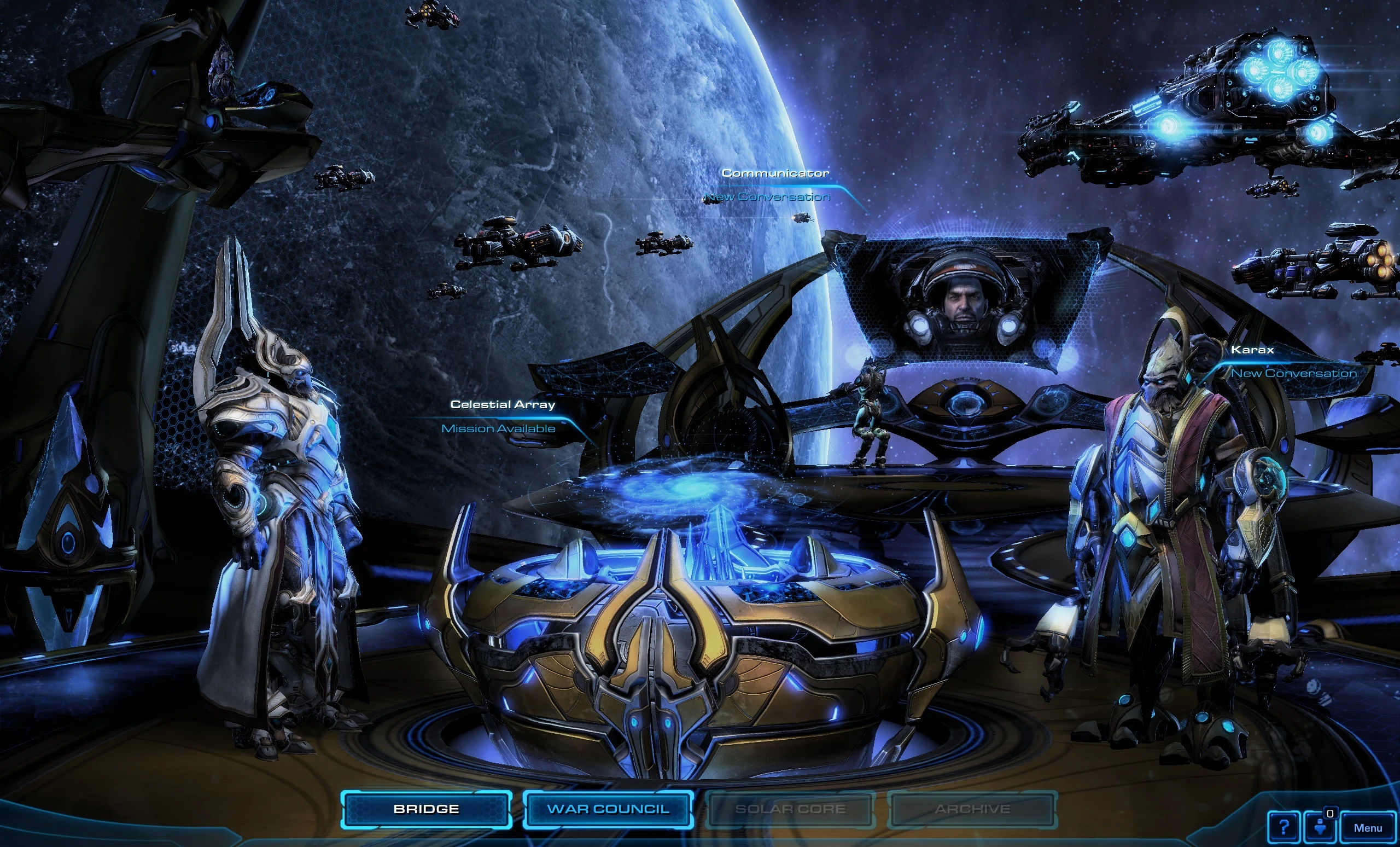
During singleplayer campaigns, some strategy games might have a 'hub' or a location they will visit between missions, and make certain decisions that will affect gameplay. In Starcraft 2, the player is transported to their ship after missions, and can interact with certain characters and speak about their opinions and what they advise.
 |
| (Source) |
Audience
I would say that it isn't very easy to define the audience for strategy games, as there are many types of games that fit into the genre, and cover a wide variety of people.
Many strategy games focus on violence, in some form or another, which I believe would not appeal to women as much as it would for men.
Many of the games also require good focus and reaction times, which may be more suitable for a young adult audience, as they would be at their 'peak'. Some strategy games are quite slow-paced, which could be more suitable for younger people, and also quite older people too.
Conclusion
To conclude, I believe that the majority of strategy games can be easy for people to get into, but can be extremely difficult for people to master, meaning that it takes practice, skill, and dedication to become 'good'. I believe this to be why the competitive scene in strategy games is so large, because it is very entertaining to see those who have mastered the game compete against each other.



No comments:
Post a Comment