The
Hypodermic Needle Model
This theory says that mass media can influence large groups of people by 'injecting' them with certain messages to trigger the responses that they want. This theory originated in 1938 when 'The War of the Worlds' was broadcast on radio, and accidentally caused widespread panic when some people believed the broadcast was real.
This theory was later proven to be untrue, as researchers found that people are much more likely to be influenced by other people, especially those close to them.

The
Inoculation Model
This theory is used to show that people can be influenced so that their own opinions are reinforced, and are more likely to further resist new or conflicting ideas, and reject any persuasion to anything they don't believe.
The idea is that the receiver must be given arguments against their beliefs, not strong enough to change their view, but enough to make them defensive. Over time, the receiver would be able to create stronger defensive arguments.
The idea is that the receiver must be given arguments against their beliefs, not strong enough to change their view, but enough to make them defensive. Over time, the receiver would be able to create stronger defensive arguments.
The
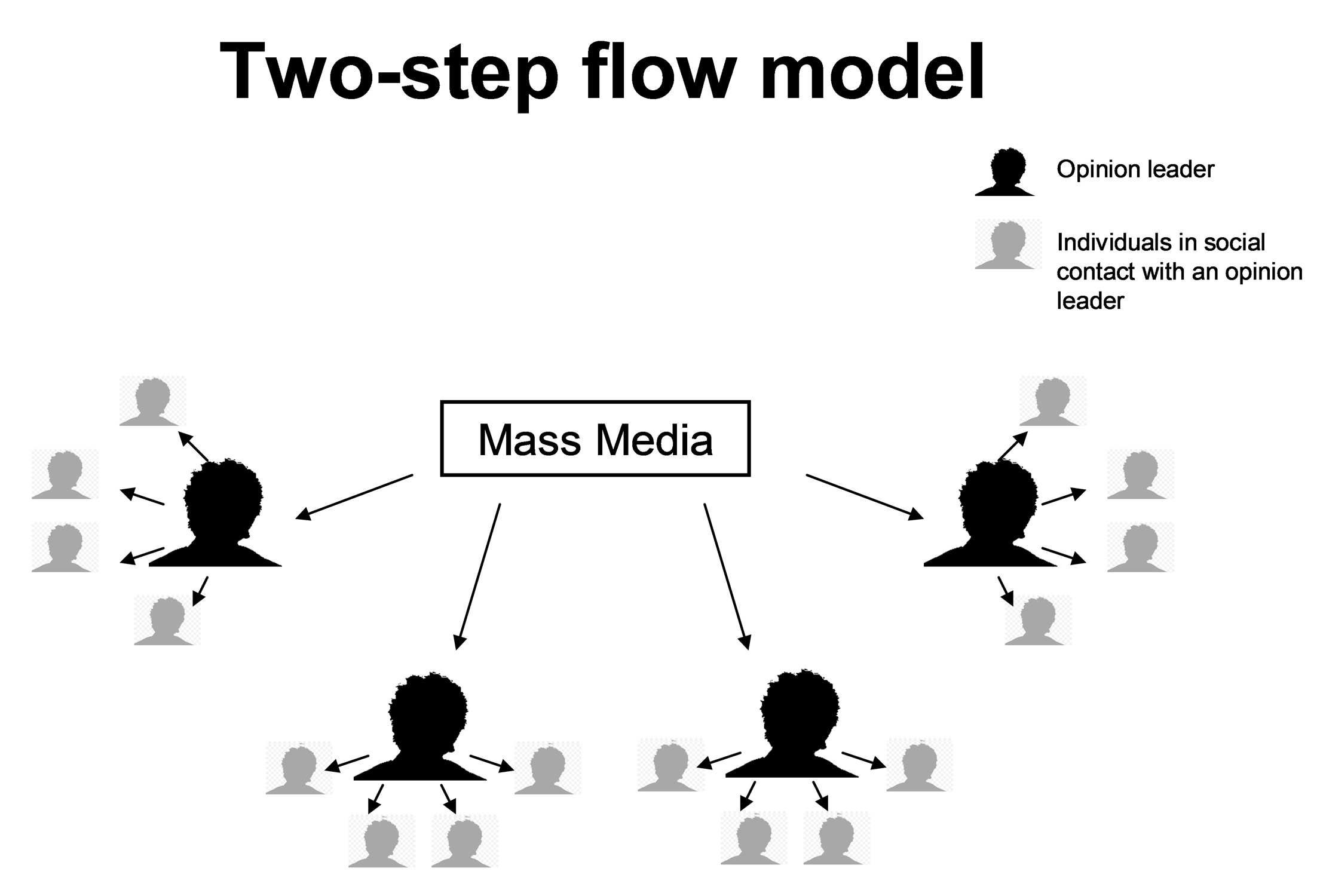
Two-Step Flow Model
This theory says that most people have their opinions influenced by 'opinion leaders', who are influenced by the media, meaning that the wider population is influenced indirectly by the media.
A modern example of this model at work is with youtubers as the opinion leaders. With youtubers, the relationship with the audience is much more personal than directly with the media, and the audience may be more likely to believe what the youtuber tells them from the media.
 |
| (Source) |
The Uses
& Gratifications Theory
This theory attempts to explain why and how people use media. It says how people deliberately pick media which suits their needs for relaxation, knowledge, social interaction, etc.The theory assumes that people actively consume media, instead of sitting passively. The audience has power over media, as the media changes and adapts to try and suit the audience's desires, while competing with other kinds of media.
The
Reception Theory
The reception theory says that the media isn't passively accepted by the viewer, but is interpreted in different ways based on their background and experiences. People with very different experiences may interpret media in completely different ways.


No comments:
Post a Comment